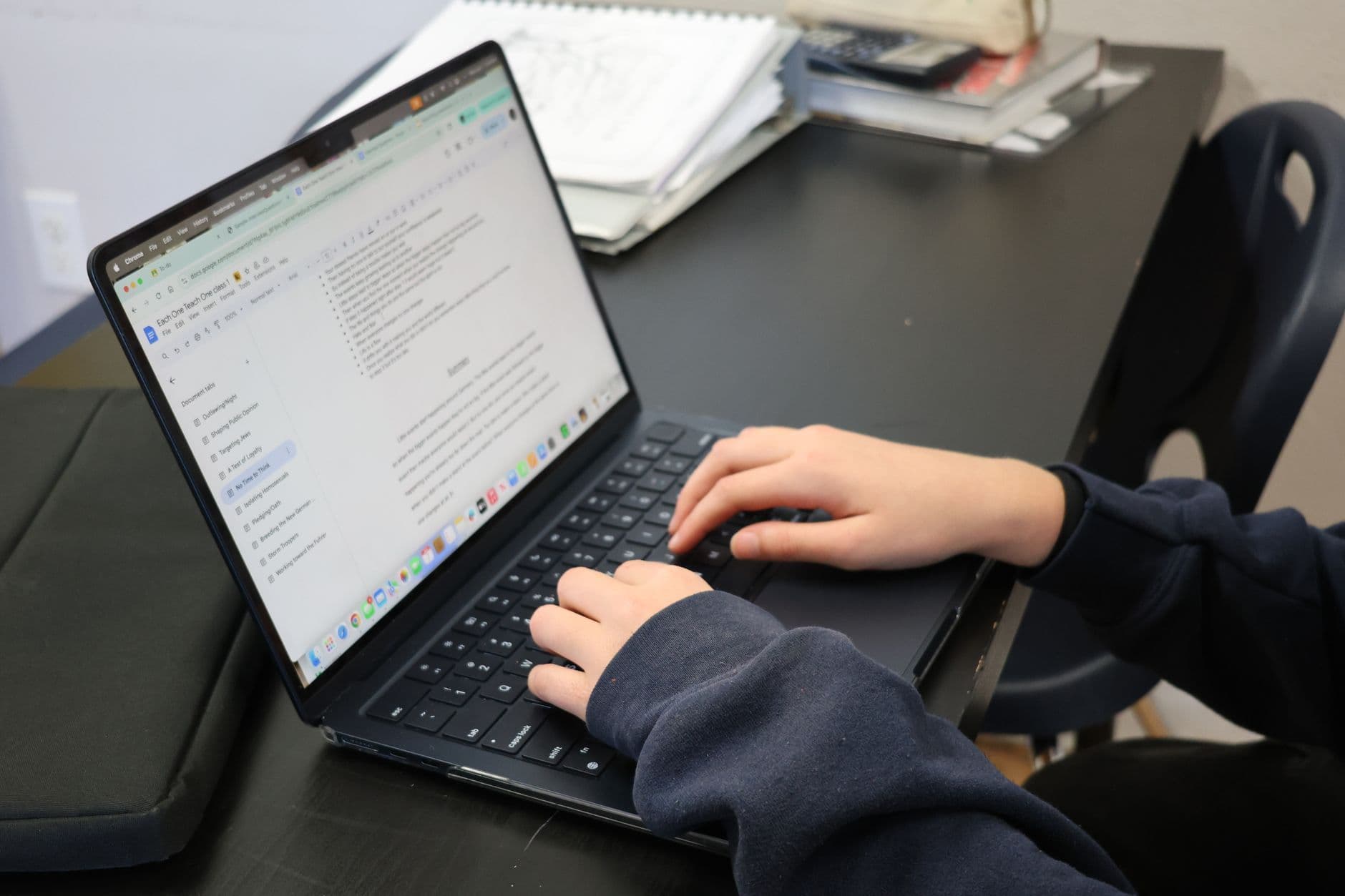
Edgenuity, now part of Imagine Learning, does not publicly document a built-in AI writing detector the way Turnitin documents its AI indicator. Search results implying otherwise are mostly guesswork stacked on guesswork. What Edgenuity verifiably has is a plagiarism-checking layer on written work, teacher review of submitted assignments, and district-level policies that increasingly bolt external tools onto everything students submit. So the accurate answer to what detector Edgenuity uses is: possibly none natively for AI specifically, and whatever your district added. Here is what that means in practice for how work on the platform actually gets checked.
What Edgenuity verifiably checks
- Plagiarism screening on written responses: the platform has long offered similarity checking against existing sources for essay-type answers, which is source matching, not AI-origin detection.

- Teacher grading of written work: short answers and essays route to a human grader in most configurations, and humans notice register shifts instantly.
- Activity data: time-on-task, progress patterns, and attempt logs are visible to teachers, and a five-paragraph essay submitted ninety seconds after opening the prompt tells its own story.
Notice what that list does: it catches most AI misuse without any AI detector at all. Copied AI text that matches web sources trips the similarity layer; instant submissions trip the activity log; and prose that reads nothing like your other work trips the grader.
The distinction people miss: platform versus district
Whether an AI detector touches your Edgenuity work is mostly a district decision, not a platform feature. Districts export written work into their own checking workflows, some run submissions through Turnitin, Copyleaks, or GPTZero on the side, and teachers paste suspicious passages into free detectors on their own initiative. None of that appears in any Edgenuity documentation, and all of it is common. The practical takeaway for students: the absence of a documented platform detector tells you nothing about whether your work gets screened.
The same pattern holds across school platforms; the companion case is does Google Classroom detect AI, where the platform likewise ships no detector and the checking happens around it.
How AI-written work actually gets caught on Edgenuity
- Style mismatch: a teacher who has graded your short answers all semester reads one paragraph of model-polished prose and pauses. This is the number one mechanism and always has been.
- Vocabulary above the course: models write like models. An eighth-grade response deploying graduate transitions is its own flag.
- Uniform rhythm: even without tools, evenly weighted sentences in identical shapes read generated to anyone who grades at volume.
- The follow-up question: online programs lean on verbal checks precisely because the platform is remote. If you cannot discuss what you submitted, the discussion is the finding.
Teachers' full toolkit, with and without software, is laid out in how can teachers detect AI writing.
From the field: a credit-recovery teacher described their actual workflow to us. No detector subscription, no district tool. They keep each student's first week of written answers as a baseline and compare anything surprising against it. In their words, the baseline catches more than any percentage would, because students who outsource their writing do not outsource it consistently.

If you use AI to help with Edgenuity work
Policy first: many districts now have explicit AI rules, and Edgenuity coursework falls under them like everything else. Where assistance is permitted, the standard applies unchanged: the submitted words should be yours, at your level, in your voice, and defensible in a conversation.
If you drafted with permitted help and want to know how the prose scores statistically, a free AI detector answers in seconds.
Where a permitted draft reads mechanical, our free AI humanizer restructures rhythm, and your edit should then pull the vocabulary back to your actual level, because passing a detector while writing three grades above yourself defeats the purpose.
- Match your baseline. On a platform where a human compares you to you, consistency is the whole game.
Frequently asked questions
Does Edgenuity have a built-in AI detector?
No publicly documented one as of 2026. It has plagiarism checking and teacher review, and districts frequently add external AI checking on top.
Can Edgenuity see if I copy and paste?
The platform's similarity checking catches pasted text that matches indexed sources, and some configurations restrict pasting in the interface itself. Separately, instant-submission timing in the activity log is visible to teachers either way.
What AI detector do schools use with Edgenuity?
Whatever the district licenses: Turnitin and Copyleaks are common institutionally, and individual teachers use free tools ad hoc. The college-side version of this question is covered in what AI detector does Turnitin use.
Is using ChatGPT on Edgenuity cheating?
That is your district's AI policy, not a platform question. Where it is banned, it is cheating regardless of detection; where limited use is allowed, the submitted work still has to be genuinely yours. Check the policy before the tools.
How accurate are the detectors teachers might use?
Probabilistic, with documented false positives, which is why good programs treat scores as conversation starters rather than verdicts. The evidence base is in are AI detectors accurate.
How this was made: this post predates this site's "How this was made" disclosure convention, which was added 2026-08-16. Drafting was AI-assisted with human editing. This paragraph and the diagram above were added during a 2026-09-26 accuracy pass; the diagram restates points this post already made, and no claim in this post was re-verified beyond what is stated above.